This was the week of Claude Cowork. If you somehow missed all the buzz, Simon Willison has a great summary. Suffice to say it’s a big development, and worthy of all the attention.
Cowork lifts Claude Code out of the command line and into a GUI application. The consensus take is that this brings the power of Code to a non-technical audience. Breathless claims abound on Twitter that this represents a turning point: that agents and AI-powered interfaces will now grow beyond their traditional developer audience and make their way into the mass market.
I completely agree that’s going to happen, and I love Cowork. But I’m less sure that it’s the definitive herald of the future, or even indicative of how we’ll get there.
Why? Because if you poke around Cowork for more than a few minutes, it becomes clear that you’re still using a CLI chatbot. Sure, Cowork transforms some responses into clickable interfaces like multiple choice buttons and tucks away ugly reasoning chains and tool calls inside of collapsed accordions. But for all that, you’re still fundamentally having a text chat conversation with Claude Code. All the same sausage is still being made, it’s just being (unevenly) hidden from your view.
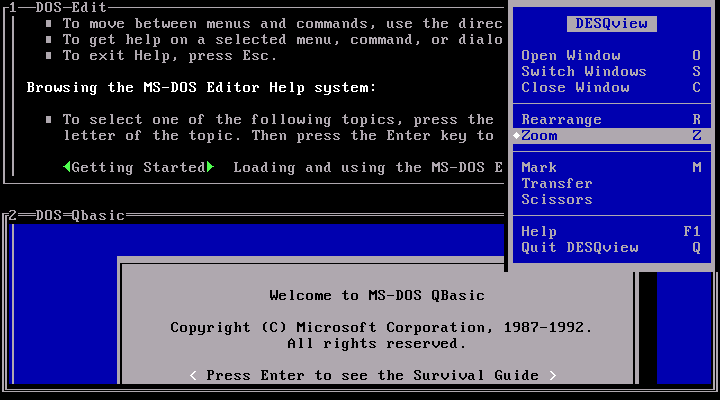
I think Brian Chesky nailed it when he said recently, “We’re in the MS-DOS phase of AI.” Claude Cowork, then, isn’t “the Macintosh phase,” or even the “Windows 1.0 phase.” It’s more like “the DESQview phase.” It’s a layer on top of the existing system that pretends to be a GUI but can’t fully deliver on that promise because it still has both feet firmly planted in the CLI world.
Cowork is great and it’s going to have a big impact. But GUI-skinned command line apps didn’t get us to the future last time. I’m skeptical that this time will be different.